
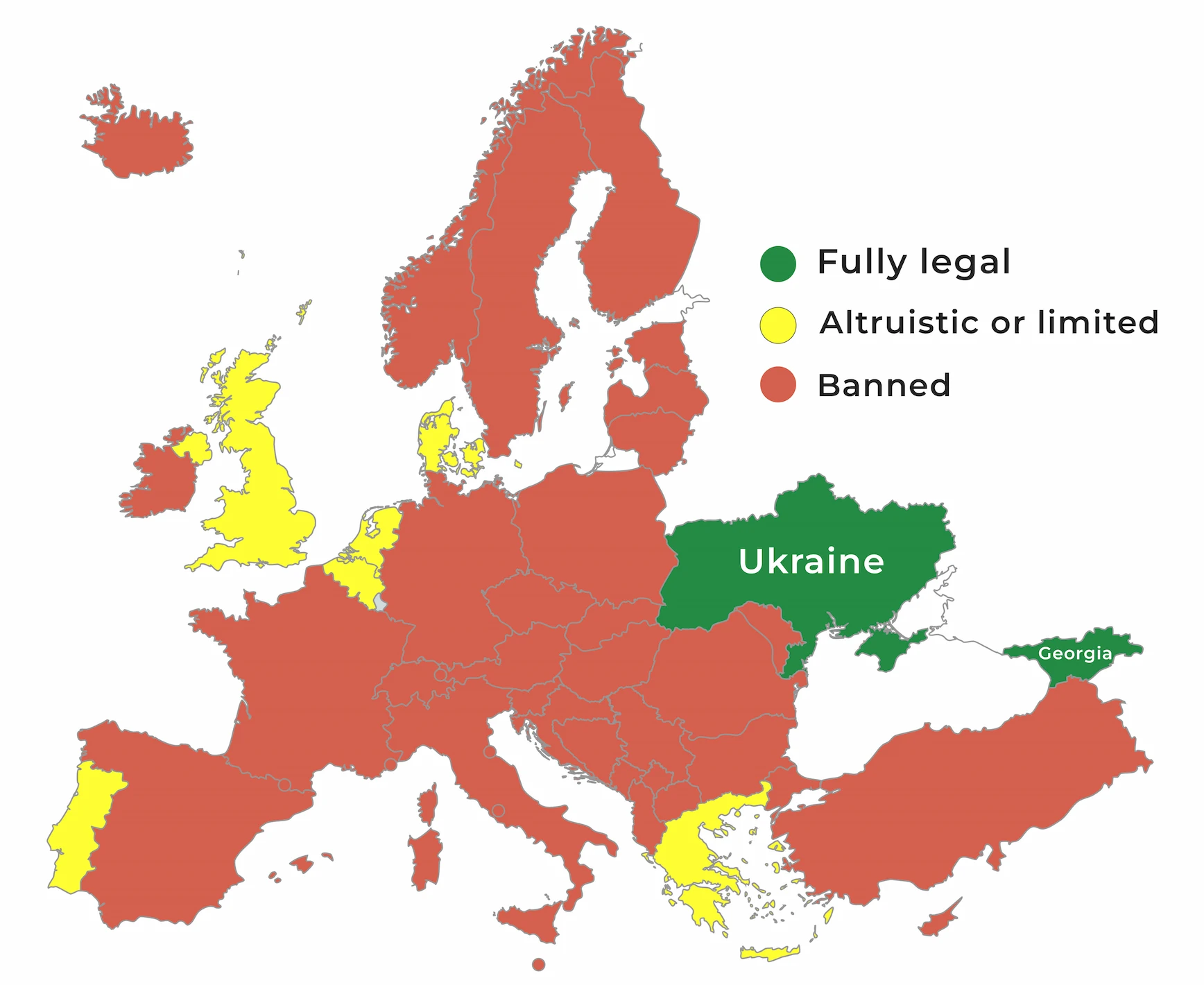
Surrogacy remains one of the most unevenly regulated aspects of reproductive medicine across Europe. While a few countries have established clear legal frameworks allowing certain types of surrogacy, many others either restrict or ban it outright – often leaving intended parents confused and vulnerable. Understanding the legal status of surrogacy in different European jurisdictions is essential before initiating the process, especially for international arrangements.
Types of surrogacy and their legal impact
There are two primary forms of surrogacy: altruistic and commercial. Altruistic surrogacy involves no financial compensation for the surrogate beyond coverage of her medical and reasonable living expenses. Commercial surrogacy, by contrast, includes payment for the surrogate’s services.
In Europe, this distinction has serious legal implications. Most countries that permit surrogacy allow only altruistic versions. Commercial surrogacy is widely prohibited and, in some countries, criminalized. Another crucial legal aspect is parental recognition. In many European legal systems, the woman who gives birth is presumed the legal mother, even when she is not genetically related to the child. This default complicates the legal status of intended parents, particularly in international cases.
Countries where commercial surrogacy is fully legal and regulated
There are only two countries in Europe where commercial surrogacy is explicitly legal, regulated, and accessible to foreigners:
- Ukraine: Commercial surrogacy is permitted for heterosexual married couples who provide proof of medical infertility. Foreign citizens are allowed to participate, and intended parents are recognized as the child’s legal guardians from the moment of birth. Ukraine has become one of the leading international destinations for surrogacy.
- Georgia: Georgia offers a similar legal framework, allowing commercial surrogacy for both local and international couples. The legal process assigns parental rights to the intended parents at birth, bypassing the need for postnatal court orders.
Both countries have developed a well-established infrastructure of fertility clinics and agencies that work with international clients. While the ongoing political situation in Ukraine may impact accessibility, the legal foundation remains one of the clearest in Europe.
Countries where altruistic or limited surrogacy is allowed under conditions
Several countries in Europe allow some form of surrogacy, but only under restrictive or non-commercial conditions:
- Greece: Altruistic surrogacy is legal and regulated. Both Greek citizens and foreigners may access it, provided a court grants prior approval before embryo transfer.
- United Kingdom: Altruistic surrogacy is permitted. Intended parents must apply for a parental order after birth to become the legal parents.
- Portugal: Surrogacy is allowed for Portuguese residents only, and only in medically justified cases. It requires prior ethical approval and is strictly altruistic.
- Netherlands: While commercial surrogacy is banned, altruistic arrangements are tolerated in practice. There is no specific legislation, and legal recognition depends on postnatal adoption.
- Denmark: There is no formal legal ban on altruistic surrogacy, but contracts are not enforceable. Clinics are discouraged from participating
- Belgium: The country has no dedicated surrogacy law, but certain hospitals may allow altruistic surrogacy under the oversight of ethical committees.
In all of these countries, legal and procedural ambiguity can complicate the process, especially when it comes to confirming parenthood, securing documentation, or navigating cross-border legal challenges.
Countries where surrogacy is banned or legally unrecognized, but not always prosecuted
Some European nations take a firm legal stance against surrogacy, yet in practice, enforcement may be inconsistent. Many intended parents from these countries seek surrogacy abroad despite potential legal risks:
- Germany: All forms of surrogacy are prohibited. Facilitating or participating in surrogacy arrangements is subject to criminal penalties.
- France: Surrogacy is banned, and foreign surrogacy arrangements are not recognized. Children born through surrogacy abroad often face legal limbo.
- Spain: Surrogacy contracts are void, and Spanish law does not allow surrogacy domestically. While many couples travel abroad for surrogacy, recognition of parenthood remains complex.
- Italy: Surrogacy is criminalized. Intended parents, agencies, and medical providers may face prosecution.
- Sweden: Surrogacy is not permitted under Swedish law, and authorities do not support recognition of surrogacy-born children abroad.
Though legal prosecution is relatively rare, these countries present serious obstacles when it comes to registering children, granting citizenship, or issuing travel documents. This uncertainty often requires court action and can lead to long delays.
Cross-border surrogacy and the legal gaps
Because of restrictive domestic laws, many intended parents opt for cross-border surrogacy in more permissive jurisdictions. However, this approach brings its own challenges. Even if the country of birth legally recognizes the intended parents, the home country may not – resulting in difficulties obtaining birth certificates, passports, and citizenship.
The European Court of Human Rights has intervened in several cases where national authorities refused to recognize parent-child relationships formed through surrogacy abroad. While the court has ruled in favor of protecting children’s rights, these decisions have not always led to immediate or consistent changes in national policies.
Legal consultation in both the country of surrogacy and the home country remains essential. Without dual legal clarity, parents may find themselves caught between systems.
Why parents turn to surrogacy abroad
The reasons intended parents seek surrogacy abroad are varied. Countries like Ukraine and Georgia offer legal certainty, affordability, and a structured process. For some couples – especially those who are single, same-sex, or medically infertile – options at home simply do not exist.
Even in countries where altruistic surrogacy is legal, the process can be emotionally and logistically difficult, due to the lack of enforceable contracts or limited access to willing surrogates. In contrast, regulated surrogacy programs abroad often offer more predictability and support.
What to keep in mind before starting
Anyone considering surrogacy in Europe – whether domestically or abroad – should begin with thorough legal research. Local laws, eligibility criteria, and recognition procedures vary significantly. It is vital to consult legal experts who specialize in reproductive law.
Beyond legality, ethical practices matter. Transparency, surrogate protection, informed consent, and respect for the child’s future rights should guide every decision.
Intended parents should also ensure that agencies and clinics are reputable and compliant with all local regulations. They must prepare for complex paperwork, including birth registration, parental recognition, and travel documentation.
Planning for long-term outcomes – such as citizenship, identity, and legal status – is just as important as the immediate goal of bringing a child into the world.
Despite the fragmented legal landscape, surrogacy in Europe remains possible with careful planning. For many families, the result is not just a successful birth, but a journey that begins with legal certainty and ends in new life.